
Methods & Techniques
How does No-Fault Communication™ work?
- Effective Speaking Skills - Germane and Clear Communication
- Effective Listening Skills - Mirroring with Emotional Intelligence & Empathy.
- Naming Strategies - Helping to indentify the good intention behind them.
- Behavior Preference Mapping (BPM) - Knowing your characteristic preference for Inclusion, Control and Openness and of your team members.
- Determining Significance of Priorities - Balancing organizational realities and human needs.
- Evaluating lines of Communications: Formal and Informal
- Coaching and Facilitation - Meta or neutral third party to keep on point.
Speaking what is Plain and Germane
 Understanding what is germane or relevant in a moment of communication takes critical reasoning and deduction. To yell fire in a crowded room maybe relevant but is not as useful as saying "make your way to the exits now." Learning to be Meta and quickly decide the:
- who? - who does the message needs reach?
- what? - what do they need to know? what will make them grasp the significance of the information? what will provide them an accurate scope of the task as to make it complete?
- when? - now? later? Is it too late? timeliness is key.
- where? - in private? informally at an open space? formal meeting?
- how? - deliver the information by written format? in person? with witnesses? laterally - coworkers? vertically? Up to a supervisor? Down to an subordinate?
- why? - what conclusion have you drawn as to the significance of the infomation?
The relationship between what one holds as truth also called values, is entirely related to one’s emotional charge with it. Truth’s can be held in place by both pleasurable and painful emotional associations. Because of the over simplification that many of us have been taught to term things: good or bad or positive or negative; by extension, we will tend to form a general categorical relationship to emotions. Then learning when are appropriate times and means to communicate these aspects to other key players in your life, and the situation where they might be germane.
Cycle of Context – X Model
- X event occurs
- You have an emotion. Juice level from 1-10.
- Your Mind forms a Meaning.
- You choose a strategy to cope.
- Memory is formed. The situation and emotions, reactions & thoughts are stored.
- You become vigilant for like situations.
- You begin to project onto other events with similar triggers all aspects of the context.
If a problem or pattern that continues with someone or in general…ask yourself:
- Have I said what I really want?
- Do I have an agenda I haven’t realized and hence not shared?
- Is there something that I am not saying because I am concerned with how it will make me look, feel, or what it might reveal?
- If you are really interested in getting to the bottom of something ask:
- What emotion comes up with this issue?
By educating business people and employees at all levels how to discover and decipher the emotional 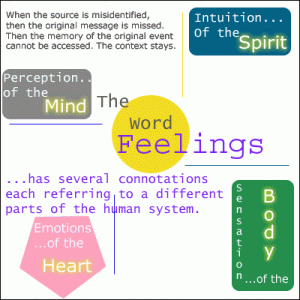 content of any communication, then faster and succinct information exchanges accompany constructive release of blocks in those channels. Assisting people to relearn and give names to the authentic motivations using primary emotional labels will have a startling affect upon the way that everyone experiences interchanges. Labeling emotions and the thoughts they lock in place is far more than feel-good catharsis; it is a real means of eliminating costly systemic blocks on the human side of an information system. The results can lead to relinquishing strategies of relating to others that are both unproductive and unfulfilling.
Contexts produce strategies that seek safety so that we can get gotten.
 The thing about strategies is: they have the unintended effect of creating consequences that we could not have forseen. We end up living like every move is a like a shot in a billiards game. The key difference between this scenario and real life is simply that this game robs us of discovery and sponteneity.
- Certainty: If I know for sure
- Confidence: I wont have to fear
- Happiness: I’ll feel to good to fear
- Power: I can defeat my fear
- Control: I will be able to limit what threatens me.
- Band-aiding or Positive Spin: Look on the bright side, minimize or be optimistic
- Allies that Placate: I feel better or stronger because someone agrees with me.
My attitude is straightforward: telling ones’ own truth is the key being liberated from fear driven strategies that lock up ones potential and deprive us of peace of mind. 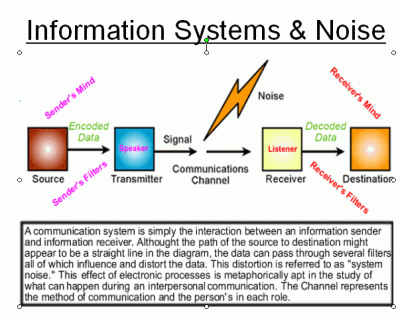
Along with its’ forerunner Loving Communication™ both were designed to assist first individuals, and now groups, clear the “noise” from their own internal information system which produces distorted communications. Recapturing the inner resources of previously stifled or repressed emotion can facilitate the greater funding of expanded creativity or the prized “outside the box” problem solving.
Whomever one is supposted to communicate with, is often not the one who is spoken to first. Informal communication lines, or "gossip networks" often reflect the reality of how people adapt to incompatible ICOA match-ups with those who they are working with.
My role as the Trainer and the coach/facilitator is to be the neutral or Meta outside agent that can bring understanding to an existing workplace or family paradigm (which we call a context) which are operating and may have run a company for a long time.
Privacy Policy | Terms of Use ©2007 Cocconi Enterprises. LLC